
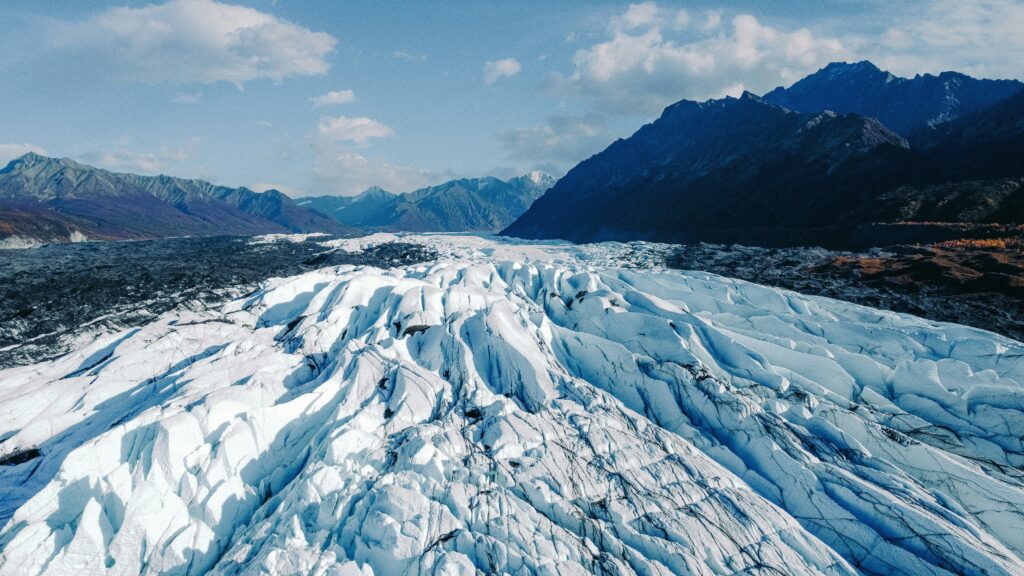
A glacier may look completely still, but it is not. Beneath its frozen surface, enormous masses of ice are slowly moving, shaping the land around them over years and even centuries.
What we see today is the result of snowfall that accumulated, survived season after season, and gradually changed into dense ice. Over time, that ice became thick enough to move under its own weight. Glaciers now form some of the most remarkable landscapes on Earth while storing freshwater and supporting rivers, ecosystems and human life far beyond the mountains where many of them begin.
We often hear about glaciers when they are melting or retreating. But before asking what is happening to them, we need to understand what they really are, how they form and why they matter.
What Are Glaciers?
A glacier starts with snow, but it does not remain snow. In places where snowfall repeatedly survives the warmer months, layer after layer settles over what came before. The weight of the newer snow gradually compresses the older layers, changing them into denser and denser ice. Given enough time and enough accumulation, the ice becomes thick enough to move.
That is what gives a glacier its meaning. A glacier is a persistent mass of snow-derived ice that forms on land and flows under its own weight and gravity. The movement may be extremely slow, sometimes difficult to notice even when standing beside it, but it is real. Inside the ice, pressure causes it to deform, and in many glaciers the ice can also slide over the material beneath it.
This matters because a patch of old snow, a frozen lake or a permanent snowfield is not automatically a glacier. A glacier is defined not simply by the presence of ice, but by its persistence and flow. Its ice may travel through a mountain valley, spread outward across a vast area, or form part of a much larger ice sheet.
Perhaps the easiest way to picture one is to forget the idea of a frozen block sitting on a mountain. A glacier is closer to a river than it first appears, except that its movement is measured in a very different rhythm. It carries its enormous weight forward, responds to the shape of the land, and gradually leaves its mark behind.
Once we understand that a glacier is moving ice formed from accumulated snow, rather than simply stored ice, the next question becomes much more interesting: how does ordinary snowfall eventually become something capable of flowing across the land?
How Do Glaciers Form?
A glacier begins with something as ordinary as snowfall. But falling snow alone does not create a glacier. The crucial part is what happens to that snow after it reaches the ground.
In places where enough snow accumulates and survives through the warmer months, one layer begins to settle over another. Year after year, fresh snowfall buries what came before. The growing weight gradually presses the lower layers together, leaving less space between the snow crystals.
Over time, the snow changes. It becomes denser and more compact, passing through a stage known as firn, which is older and more tightly packed than fresh snow. Continued pressure and the gradual rearrangement of its ice crystals eventually turn the firn into dense glacier ice.
But the formation of glacier ice is only part of the process. As the mass of ice becomes thick and heavy enough, gravity causes it to move. The movement is usually too slow for us to notice from one moment to the next, yet over years and centuries it can carry the ice through valleys and across the landscape.
Whether a glacier continues to grow depends on the balance between what it gains and what it loses. Snowfall and other forms of accumulation add mass, while melting, evaporation and ice loss remove it. This balance varies from place to place according to factors such as temperature, elevation, precipitation, and local climate.
So, in its simplest form, glacier formation is a long natural transformation:
snowfall → accumulation → compression → firn → dense ice → movement
The process may look ordinary at first, but its timescale is extraordinary. A layer of snow that falls today may become part of a glacier only after years of burial and transformation.
There is also a small lesson in that process. Fresh snow does not remain as it first falls. Time, pressure, and its surroundings gradually change it into something different.
Human beings are shaped in much the same way. We do not remain exactly as we were years ago. Time, experience, pressure, and the circumstances we pass through leave their mark on us. Change is not always a sign that something has been lost. Sometimes, it is simply the natural result of having lived.
How Do Glaciers Move?
A glacier may look like a solid, motionless mass, but it is constantly moving. Gravity is the main driving force, pulling the enormous mass of ice downslope and outward from areas of greater elevation. The movement is usually far too slow for us to notice from one moment to the next, but over years and decades, a glacier can travel considerable distances.
The surprising part is that ice can actually flow. Under the immense pressure created by its own weight, glacier ice can deform internally, with individual ice crystals slowly shifting and rearranging. In some glaciers, the ice also slides over the ground beneath it. Meltwater at the base can reduce friction and make sliding easier.
How fast a glacier moves depends on more than gravity alone. Slope, ice thickness, temperature, meltwater, and the surface beneath the glacier all influence its speed. A steeper slope can increase the gravitational force acting downslope, while thicker ice can experience greater driving stress. Warmer ice generally deforms more readily, and water beneath the glacier can sometimes allow it to slide faster. Rough or uneven ground, on the other hand, can resist movement.
The way snow has accumulated and transformed into ice also matters indirectly. A glacier’s thickness, structure, and temperature develop through its long history of accumulation and ice formation, and these characteristics affect how it responds to gravity. Wind can also redistribute or remove snow from the surface, influencing where a glacier gains mass, although it is not the main force that drives the glacier forward.
Glacier movement is therefore not a simple downhill slide. It is the result of gravity acting on a huge mass of ice, combined with the properties of the ice and the landscape beneath it. Some glaciers move only a few centimeters per day, while others can move much faster. During a glacier surge, a glacier may temporarily accelerate dramatically.
What looks like stillness from the outside is a slow journey through the landscape.
Where Are Glaciers Found?
Glaciers are not spread evenly across the Earth. They are concentrated in places where snow and ice can survive for long periods, especially in the coldest parts of the planet and at great elevations. Their distribution reflects the close relationship between latitude, elevation, temperature and precipitation.
Glaciers in Polar Regions
The polar regions are home to the vast majority of Earth’s glacier ice. Antarctica and Greenland alone contain more than 99% of the planet’s land ice, showing just how strongly glacier ice is concentrated toward the poles.
This distribution is closely connected to the shape of our planet. Because Earth is curved, sunlight reaches the polar regions at a much lower angle than it does near the Equator. The same solar energy is spread over a larger surface, so these regions receive less heating. As a result, temperatures remain low enough for snow and ice to persist for long periods.
That persistence matters. Where temperatures are low and snowfall continues to add new layers, snow can survive from one year to the next instead of disappearing during the warmer season. Over long periods, these layers accumulate, become compressed, and gradually form vast bodies of glacier ice.
Yet cold alone is not enough. A glacier also needs a continuing supply of snow. Some polar areas are extremely cold but receive very little precipitation, so they do not necessarily accumulate ice rapidly. Temperature determines how easily snow can remain, while precipitation supplies the material that allows glacier ice to build.
The polar regions, therefore, are not simply places that are cold. They are places where Earth’s geometry, low temperatures, and the availability of snow come together to preserve and build enormous stores of ice.
Glaciers in High Mountain Regions
Glaciers are not confined to the polar regions. They also occur across some of the world’s great mountain systems, from the Himalayas and Karakoram to the Andes, Alps, Rockies, Alaska and Patagonia. Their presence in such distant parts of the world reveals an important geographical fact: latitude alone does not decide where glaciers can exist.
As elevation increases, temperature generally falls. At great heights, this can create a cold environment in which snowfall remains on the ground long enough to build year after year. This is why glaciers can occur thousands of kilometers from the Arctic, including in the Himalayas and other high mountain ranges.
There is also a striking relationship between latitude and elevation. Near the poles, glaciers can occur at relatively low elevations. As we move towards warmer latitudes, they are generally confined to higher and higher mountains. In this way, great altitude can partly compensate for greater distance from the poles.
Yet a towering mountain does not automatically carry a glacier. Height provides the cold, but snowfall provides the supply. If a mountain receives too little snow, or if local conditions cause that snow to disappear too quickly, a permanent glacier may never develop there. This explains why even some impressive mountain ranges have little or no modern glacier ice.
Outside the polar ice sheets, some of the world’s most extensive mountain glaciers are found in Alaska, Patagonia, the Andes and the Himalaya–Karakoram region. Their locations remind us that glaciers are shaped by a combination of latitude, elevation, snowfall and local geography, rather than by one factor alone.
Why Are Glaciers Not Found Everywhere?
If glaciers need cold conditions, it may seem logical that every very cold place should have them. But that is not the case. Temperature is only one part of the equation. A place also needs enough snowfall, and that snow must remain long enough to build a lasting mass of ice.
The McMurdo Dry Valleys of Antarctica offer a remarkable example. They are among the coldest environments on Earth, yet they are largely ice-free because the air is extremely dry and very little snow falls there. Strong winds can also remove what little snow does accumulate.
A similar contrast can be seen in the Dry Andes of South America. In the more arid northern part of the range, limited precipitation means that only permanent snow patches and very small glaciers occur in many places. Farther south, where the mountains receive greater amounts of precipitation, much larger glaciers are found.
These examples reveal something easy to overlook; being cold does not automatically make a place glaciated. The crucial question is whether snowfall can accumulate faster than it disappears. Elevation and latitude help create the necessary temperatures, while precipitation supplies the snow. Local factors such as slope, exposure, and wind can further influence where that snow survives.
However, there is no single geographical rule that tells us where glaciers must occur. They develop where temperature, snowfall, elevation, and local geography come together over time, allowing snow to accumulate, transform into ice, and eventually flow.
What Are the Main Types of Glaciers?
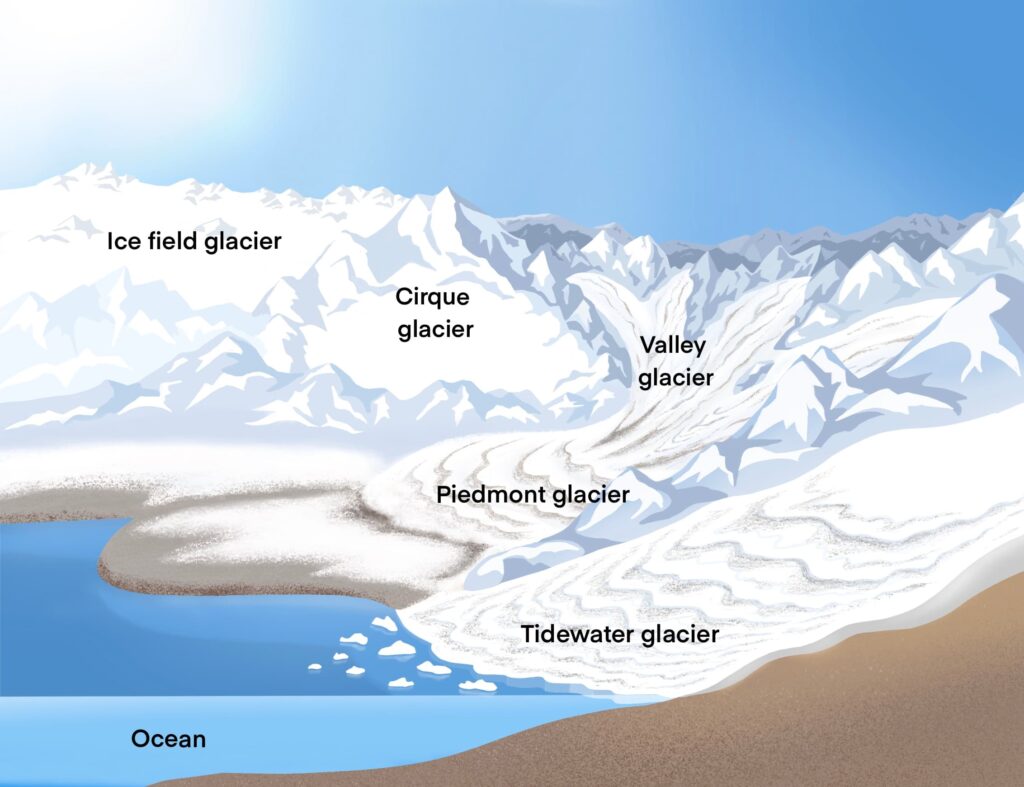
Glaciers do not all take the same shape or follow the same path. Some are confined by mountain valleys, while others spread across vast areas of land. Their form largely depends on the landscape beneath them, their size, and the way the ice spreads.
Valley Glaciers
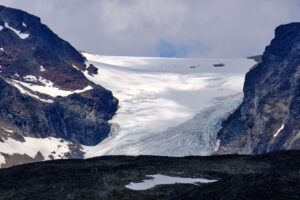
Valley glaciers form in mountainous areas and flow through existing valleys, following the shape of the land as they move downhill. They are often described as slow-moving rivers of ice because, like rivers, they are guided by the terrain around them.
Some begin in high mountain basins and gradually descend through narrower valleys. As they move, they can merge with other glaciers or spread outward when the valley opens. Their long, flowing shape makes them one of the easiest glacier types to recognize.
Ice Caps
An ice cap is a broad mass of glacier ice that covers a large area of land, usually in polar or high-mountain environments. Unlike a valley glacier, it is not confined to one valley. Instead, the ice spreads outward in several directions, forming a broad, dome-like surface.
Ice caps are smaller than ice sheets, although they can still cover thousands of square kilometers. Their movement is influenced by the shape of the land beneath them, even though the ice itself extends across the surrounding terrain.
Ice Sheets
At the largest scale are ice sheets, enormous masses of glacier ice that spread across vast areas of land. Today, only two exist: the Greenland Ice Sheet and the Antarctic Ice Sheet. An ice sheet is defined as covering more than 50,000 square kilometers.
Unlike a valley glacier, an ice sheet is not shaped mainly by a single mountain valley. Its immense weight allows the ice to spread outward in broad domes, while parts of the ice can flow through faster-moving channels towards the edges.
Other Mountain Glaciers
The three forms above give us the broad picture, but mountain glaciers can take several other forms. Cirque glaciers occupy bowl-shaped hollows high on mountains, while piedmont glaciers form when valley glaciers emerge from confined mountain valleys onto flatter land and spread outward into broader lobes.
These forms show that a glacier is not defined simply by how much ice it contains. The landscape around the ice helps determine the shape the glacier takes and the way it moves.
Taken together, these types reveal a simple but important idea: glaciers are not one uniform feature of the Earth. From a narrow mountain valley to an entire continent, the same basic material, moving ice, can take remarkably different forms depending on its surroundings.
Why Are Glaciers Important?
Glaciers are more than huge bodies of ice resting high in mountains or across polar landscapes. They store freshwater, influence rivers and ecosystems, shape the land around them, and preserve clues about Earth’s environmental past. Their importance therefore extends far beyond the places where the ice itself is found.
Freshwater Locked in Ice
When we think about freshwater, rivers, lakes and groundwater usually come to our mind. Nevertheless, much of Earth’s freshwater is stored somewhere far less visible: ice. Ice caps, glaciers and permanent snow together hold about 68.7% of the planet’s freshwater, while glacier ice itself accounts for about 2.1% of all the water on Earth.
This makes glaciers much more than frozen landscapes. They are long-term stores of water, built gradually as snowfall accumulates and is transformed into ice. The water held within them can remain frozen for years, decades or even much longer before eventually returning to the water cycle.
When glacier ice and seasonal snow melt, some of that water enters streams and rivers and moves towards lower ground. In some regions, this contribution is especially important during warmer and drier periods, when other sources of water may be limited. The importance of glacier melting, however, varies from one region to another. But when glaciers lose ice over the long term, the consequences go far beyond a change in the mountain landscape. Why Are Glaciers Melting? Explores what is driving this loss and what it could mean for the future.
What makes this role easy to overlook is the distance between the ice and the people who may eventually use its water. A glacier can store water high in the mountains long before that water becomes part of a river system farther below. Its importance, therefore, is not simply in the ice itself, but in the place that stored water holds within the wider water cycle.
Their Influence Does Not End at the Mountains
A glacier may sit high in a remote mountain range, but the landscape it belongs to does not stop there. Streams emerging from glaciated areas join larger rivers, pass through valleys, and continue towards lower ground. What begins as ice in the mountains can therefore become part of a much wider geographical system.
The journey downstream brings constant change. Water meets rock and sediment, nourishes vegetation and passes through different elevations and habitats. In some high-mountain streams, the cold conditions support specialized species of aquatic invertebrates that are closely adapted to these environments. Farther down, changing temperatures, terrain, and vegetation allow other forms of life to flourish. Hence, a single river system can contain many different ecological settings along its course.
The significance is not limited to wildlife. In many mountain regions, river systems connected to snow and ice support farming, grazing, settlements, hydropower and local livelihoods. People living far from the glacier may never see the ice that lies upstream, yet they can still be connected to the same mountain water system. The distance between the glacier and a community does not necessarily mean the two are unrelated.
There is something quietly powerful about this relationship. A glacier does not have to be near life to influence it. Its presence high in the mountains can be one part of the chain that links water, land, habitats and human communities across an entire landscape.
Seen this way, glaciers are not isolated masses of ice. They are part of the geography around them, and their influence can extend far beyond the places where the ice itself is found.
More Than Ice: Landscapes, Life and Earth’s Past
A glacier leaves its mark even where the ice is no longer there. It cuts valleys, moves rock and sediment, and helps shape the mountains themselves. Some of the landscapes we now see as permanent were formed through the slow movement of ice over thousands of years. Remove the glacier from that story, and we lose part of the story of how the landscape came to be.
The same is true of life around it. Glacier-fed streams, alpine meadows and newly exposed ground are home to plants, animals and freshwater species that have adapted to difficult mountain conditions. As the ice retreats, the landscape does not simply become empty. Some species move upward or spread into newly exposed areas; others, especially those adapted to cold and snow, are pushed into an increasingly smaller world. For species already living near the highest elevations, there may be little room left to move.
Then there are the people who have lived with these mountains for generations. Farming, herding, travel and everyday life in many high-mountain communities have developed around the local rhythm of snow, ice and water. The people have not simply disappeared because glaciers are retreating. Their surroundings are changing. Water may arrive at different times, pastures can change, hazards can increase, and familiar landscapes can become unfamiliar. Adaptation is possible, but it is not the same as living in the environment their communities once knew.
And perhaps most quietly, glaciers keep a record. Layer after layer of ice can preserve evidence of past atmospheric conditions, allowing scientists to look back into Earth’s climate history. Therefore, a glacier is not only part of the landscape we see today. It is also a record of a world that came before us.
That is why calling glacier loss simply melting ice misses something important. What disappears is not only ice, but parts of a landscape, habitats shaped by cold, ways of life tied to the mountains, and a physical record of Earth’s past.
What Makes Glaciers Remarkable?
Perhaps what makes glaciers truly remarkable is not only what they do, but what they can teach us.
They move without hurry. They endure immense pressure. They shape the land without making a sound. From a human perspective, their pace can seem almost insignificant, yet over time that slow movement can transform entire landscapes. A glacier reminds us that something does not have to move quickly to create lasting change.
There is another lesson in the way a glacier exists within its surroundings. Its ice becomes part of rivers, ecosystems and landscapes, while its presence can influence lives far beyond the mountains. Nothing exists entirely on its own. A change in one part of nature can eventually be felt somewhere else.
Probably, glaciers therefore deserve to be seen as more than geographical features. Their story carries quiet lessons about patience, adaptation, endurance and the consequences of gradual change. We study them to understand the Earth, but we can also look at them to understand something about ourselves.
I explore these ideas more deeply in “6 Life Lessons from Glaciers: What Nature Teaches Us About Growth and Survival,” where glaciers become more than a subject of geography and offer a different way of thinking about growth, struggle and survival.
Conclusion
Glaciers are far more than ice on distant mountains. They are part of the Earth’s living system, shaping landscapes, feeding rivers, supporting life and carrying evidence of a much older world.
What makes them important is not simply what they contain, but what depends on their existence.
A glacier can take centuries to form, yet its retreat can become visible within a lifetime. That contrast is worth remembering. Nature does not always change at the speed we expect, and the things that seem permanent may not be permanent at all.
To understand glaciers is to understand a little more about the Earth we belong to, and our place within it.