

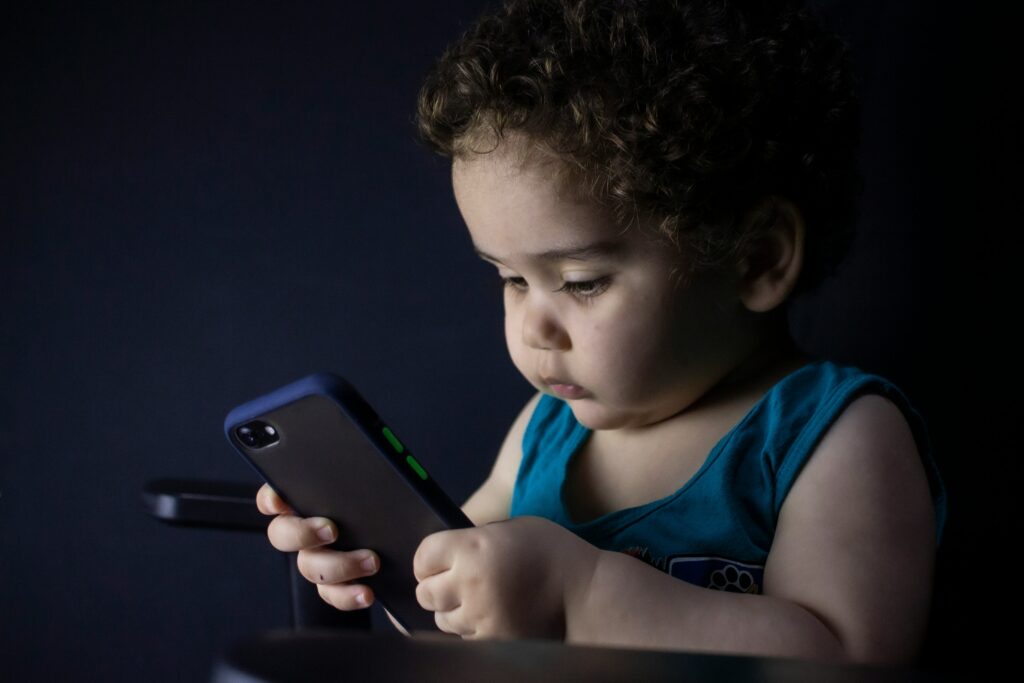
A baby is crying.
A mother hands over a mobile phone.
Within seconds, the tears disappear, and the room falls silent.
Scenes like this today have become so common that we hardly question them anymore. A cartoon during meals, a video to stop the crying, or a game to keep children occupied: what once seemed like an occasional convenience has quietly become a part of everyday parenting.
At first, it feels harmless. After all, every parent wants a moment of peace in a busy world. But what if this small convenience slowly turns into a habit? What if the same screen that keeps children quiet today quietly takes away their curiosity, patience, concentration, and desire to explore the world around them?
Technology is not the enemy, nor are parents. Yet an uncomfortable question deserves our attention: Are mobile phones helping us raise our children, or are they slowly taking over a role that no screen can replace?
What appears normal today may shape the adults our children become tomorrow. This article explores how early screen dependency develops, its hidden effects on childhood, the long-term consequences it may bring, and practical ways parents can break the habit without breaking the child.
The Digital Babysitter
Children are not born attached to screens because they become accustomed to them.
Not long ago, a crying child was comforted with a hug, a story, a toy, or simply the reassuring presence of a parent. Today, many children are introduced to a different kind of comfort is one that fits in the palm of a hand.
Most parents do not hand over a phone because they don’t love their children. They do it because life is so busy, patience runs thin, and a screen offers something every tired parent longs for: a few moments of peace.
Over time, phones begin to accompany meals, car rides, family gatherings, and bedtime routines. What starts as an occasional distraction slowly becomes an expected part of a child’s day.
Many parents no longer try to comfort, distract, or engage their children the way previous generations did. It feels easier to hand over a phone than to deal with crying, tantrums, restlessness, or endless demands for attention. After all, the screen works faster and asks for less effort.
In some cases, parents themselves become accustomed to this arrangement. A quiet child means fewer interruptions, less stress, and a lighter burden. Gradually, convenience becomes normal, and what once felt temporary begins to feel necessary.
Meanwhile, children are learning something too. They begin to expect constant stimulation whenever they feel bored, upset, or impatient. Instead of learning how to wait, observe, imagine, or deal with comfortable feelings, they gradually learn to avoid them.
Convenience often solves today’s problem while quietly creating tomorrow’s habit.
A mobile phone was designed to entertain, not to replace hugs, conversations, patience, and the countless little moments through which children learn about the world around them.
Screens can keep children occupied but they cannot raise them.
Why Screens Are So Addictive
A child enters the world knowing very little. They learn by watching, imitating, and adapting to the environment wherein live. In many ways, childhood is a process of copying what feels familiar. Habits that are repeated often soon become normal.
At the same time, digital experiences are built to hold attention. Bright colors, movement, sounds, and endless entertainment make them naturally appealing to the young minds. Unlike toys or books that are eventually put away, screens rarely feel complete. One thing ends, and something else is already waiting. There is always another video to watch, another level to play, or another picture to explore.
As a result, stopping does not come naturally. The experience keeps going, while moments of stillness become fewer.
But those dull moments matter. Boredom is not always a problem to be solved. It is often in those quiet pauses that children imagine, observe, ask questions, and discover things for themselves. When every empty moment is filled instantly, those opportunities become fewer.
Children are not the only ones who struggle with screens. Even most adults know what it feels like to pick up a phone to check one message and end up spending far more time on it than they intended.
The problem is not that children love screens. The problem is that screens rarely give them a reason to stop.
And when endless stimulation becomes normal, ordinary life can begin to feel less interesting by comparison.
The Warning Signs of Mobile Addiction in Children
The effects of excessive screen time rarely appear all at once. More often, they show up through small changes that are easy to overlook.
Early childhood is naturally full of curiosity. Children want to touch things, ask questions, run around, make a mess, and turn ordinary moments into adventures. That is why it becomes concerning when their interest in the world around them slowly gives way to a preference for the screen in their hands.
Many parents have noticed that activities which once brought joy: playing with toys, reading picture books, walking outside, or simply playing with soil and everyday objects are no longer hold the same appeal. The screen becomes more exciting, while physical play gradually takes a back seat.
Changes can also be seen in simple conversations. Responses become shorter, eye contact becomes less frequent, and attention drifts elsewhere. Some children may answer with a quick “yes” or “no” but show little interest in engaging with the people around them. Being in the same room is not always the same as being truly present.
Human connection is learned through experience. Facial expressions, body language, emotions, and social cues are not things children are born understanding. They learn them by interacting with people. When those experiences become limited, social situations and meaningful connections may become more difficult to navigate as they grow older.
Another quiet change takes place in everyday habits. Running, climbing, exploring, and outdoor play slowly give way to long hours of sitting. These may seem like small adjustments, but habits formed in childhood often stay longer than we expect and can affect both physical and emotional well-being.
Excessive screen use is rarely the only concern. In many cases, it goes hand in hand with unhealthy eating habits, a topic explored in Why Children Are Addicted to Junk Food and What We Are Ignoring.
Perhaps one of the clearest signs appears when the screen is taken away. Disappointment is natural, but extreme frustration, endless bargaining, or emotional outbursts deserve attention.
I have personally witnessed this within my own family. When my maternal aunt takes the phone away from her child, he sometimes cries uncontrollably and keeps pleading for a few more minutes. On certain occasions, his frustration becomes so intense that he throws whatever object is within reach. However, the moment the phone is returned, he becomes calm again. Watching such moments is painful because they reveal how deeply a child can become attached to something they are not emotionally ready to manage on their own.
There is another sign that often goes unnoticed such as eating, traveling, waiting, family gatherings, and even bedtime begin to feel incomplete without a screen. What started as a form of convenience slowly becomes a necessity, making the habit difficult for both children and parents to break.
From my perspective the greatest concern is not that children enjoy screens, but that screens quietly replace the very experiences that help childhood flourish: curiosity, creativity, face-to-face conversations, and the simple habit of asking questions.
A child enters the world eager to learn and discover. It is heartbreaking to think that, in trying to make life easier, we may unknowingly take away some of the very experiences that help children grow.
The Future We May Regret
The future is often imagined as something distant, yet it is quietly being shaped inside our homes every day. The habits, values, and behaviors children develop today may influence the adults they become tomorrow.
According to the American Academy of Pediatrics, children spend an average of seven hours a day using entertainment media such as televisions, mobile phones, computers, and other electronic devices. While technology has undoubtedly made life easier in many ways, its excessive use raises an important question: What kind of future are we preparing our children for?
Childhood is where resilience, curiosity, communication, discipline, and independent thinking begin to take shape. These qualities are not built through constant consumption but through experiences like exploring, asking questions, solving problems, making mistakes, facing boredom, and learning from real life. When screens begin to replace too many of these experiences, children may miss opportunities to develop some of the qualities that help them thrive later in life.
The concern extends beyond individual children. Every society is ultimately shaped by its people, and today’s children will become tomorrow’s parents, teachers, workers, leaders, and decision-makers. The way they are nurtured today will influence the communities they help create in the future.
A child who rarely learns patience may struggle when life does not provide instant results. A child who spends less time communicating with others may find it harder to build meaningful relationships. A child who avoids challenges through constant distraction may have fewer opportunities to develop resilience, adaptability, and confidence. These qualities are not formed overnight; they grow gradually through everyday experiences and repeated practice.
However, the greatest concern is that many of these changes happen quietly. They may not be obvious during childhood, nevertheless their effects can gradually appear later in education, work, relationships, and everyday life. Habits developed in the early years often remain with us far longer than we realize.
Researchers continue to study the relationship between excessive screen exposure and child development. Several studies have raised concerns about its potential impact on language development, emotional well-being, attention, and social interaction, particularly during the early years when these abilities are developing rapidly.
The future of a country is not determined only by its technology, infrastructure, or economy. It is also shaped by the character, abilities, and values of its people. When children grow into curious, disciplined, resilient, and capable adults, society benefits as a whole. When those qualities are neglected, the consequences may extend far beyond individual families.
The children we are raising today will eventually shape the world we all live in tomorrow. The question is not whether technology will be part of their future, it certainly will. The real question is whether we are helping them develop the human qualities needed to use it wisely.
Breaking the Habit, Not the Child
A tree does not grow strong simply because it has been planted. It grows through care, attention, and consistent nurturing. When it is watered, protected, and guided from the beginning, it gradually develops a healthy shape. But when it is neglected, the effects may not appear immediately; they often become visible much later.

Children are no different.
The child is not always the problem. More often, the problem lies in the habits and environment surrounding the child. The earlier those habits are formed, the more difficult they become to change. That is why prevention is quite commonly easier than correction.
Perhaps the first step is for parents to reflect on their own habits. Children learn far more from what they observe than from what they are told. If parents spend most of their free time looking at screens, it becomes difficult to convince a child that screens should be used in moderation. Example is one of the most powerful forms of teaching.
Reducing screen dependence is not simply about taking something away. It is about offering something better in its place. Children are less likely to demand a phone when they are engaged in meaningful activities such as playing, drawing, reading, listening to stories, exploring outdoors, helping with small tasks, or spending quality time with family.
Children often ask for screens when they find nothing more interesting around them. A child who is busy playing, learning, laughing, exploring, or sharing moments with loved ones is naturally less likely to seek constant digital entertainment.
Simple moments frequently matter more than expensive solutions. A bedtime story, a walk together, a game in the courtyard, helping in the kitchen, or a playful conversation can leave a deeper impression than hours spent in front of a screen. Children rarely remember how expensive their toys were; they remember who spent time with them.
Grandparents can also play an important role. Their stories, experiences, wisdom, and companionship offer something technology cannot provide a genuine human connection. Sometimes children need more attention than entertainment.
Another mistake many parents make is relying on fear, anger, or punishment. Constant scolding, shouting, threatening, or abruptly snatching away a device may stop behavior for a moment, but it hardly ever addresses the root cause. In some cases, it may even create frustration, insecurity, or emotional distance between parent and child.
Lasting change is more likely to come through patience, consistency, guidance, and a strong relationship. When children feel heard, valued, and supported, healthy habits become easier to develop and maintain.
The goal is not to control children. The goal is to create an environment where healthy choices become natural and enjoyable. Habits influence childhood, but caring relationships influence children far more than screens ever will.
Insight
Much of the concern about screens comes from how attractive and engaging they are. Technology companies invest enormous time, creativity, and resources into designing digital experiences that capture and hold attention.
But what if the same creativity were invested in books, toys, educational tools, playgrounds, and learning experiences?
What if reading felt as exciting as scrolling? What if educational activities were designed with the same level of imagination used to build games and digital platforms?
However, the solution is not solely to reduce children’s attraction to screens but also to create alternatives that are equally engaging, meaningful, and rewarding.
This responsibility does not belong to parents alone. Educators, publishers, toy makers, designers, schools, creators, and society as a whole all have a role to play in shaping environments that encourage children to explore, learn, create, and connect with the real world.
The question may not simply be how to keep children away from screens. It may be how to make the world beyond screens impossible to ignore.
Children Need Us More Than Screens
Technology can entertain a child, but it cannot replace a parent’s presence. A screen may hold attention for a while, yet it cannot listen, understand, encourage, or build a genuine bond.
Years later, children are unlikely to remember every cartoon they watched or every game they played. What stays with them are the moments they shared with the people around them. A story before bedtime, a walk together, a conversation after a difficult day, or a simple moment of laughter can leave a lasting mark on a young mind.

One of the greatest gifts a child can receive is the feeling of being seen, heard, understood, and valued.
Childhood passes more quickly than we realize. The years when children seek our company, ask endless questions, and want to spend time with us do not last forever. Once those moments are gone, they cannot be brought back.
I think the real concern is not how much time children spend on screens, but how much time they spend connecting with the people who matter most in their lives.
In the end, children need guidance more than convenience, conversation more than distraction, and human connection more than digital entertainment.
The memories we create with children today may influence them far longer than any screen ever could.
A child is like wet clay. The care, habits, and values shaped in childhood often become the foundation of adulthood.