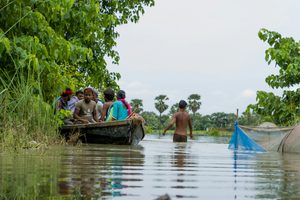

Behind every state there are millions of lives, each with its own hopes, struggles, and dreams for a better future. In Uttar Pradesh, those lives tell many different stories. A farmer waits for a good harvest. A young student works hard for an opportunity. A family struggles to find proper healthcare. Someone leaves their village in search of work, hoping to build a more secure life elsewhere. At the same time, cities are growing, businesses are expanding, and new opportunities are emerging.
This is the reality of Uttar Pradesh: a state with enormous potential, but also challenges that cannot be ignored.
Uttar Pradesh has fertile plains, important rivers, a rich history and a deep cultural identity. It has a large young population, a strong agricultural base and a growing place in India’s economy. Yet, these strengths do not automatically translate into a better life for everyone. Access to good education, reliable healthcare, stable employment, and basic public services remains uneven. The gap between what the state could achieve and what many people experience in their daily lives is still significant.
And that is what makes Uttar Pradesh important to understand. Its story is not just about population, politics, elections, or economic figures. It is also about villages and cities, farmers and workers, students and businesses, different regions and the people who call them home. Life in western Uttar Pradesh can look very different from life in Bundelkhand or the flood-affected districts of the east. Each region has its own strengths, problems, and needs.
So, an important question deserves our attention: What will it take for Uttar Pradesh to turn its vast potential into real progress for its people?
To answer this, we need to look beyond familiar facts and headlines. We need to understand its geography, economy, society, culture, politics, development challenges, and opportunities. We also need to examine what has improved, what remains difficult, and where meaningful change is still needed.
Because a state’s progress is not just about bigger cities, new projects or impressive numbers. It is about whether an ordinary person can live with dignity, receive a good education, find decent work and have a fair chance to build a better life.
That is the Uttar Pradesh this article seeks to understand.
One State, Many Realities: Understanding Uttar Pradesh
Uttar Pradesh is one state, but it does not have just one way of life. Travel from one region to another, spend time with local people, and you commence to notice differences in their language, accent, food, customs, and everyday habits. Even over relatively short distances, the way people speak can change. A familiar word may sound different, an expression may be unfamiliar, and the local way of communicating may have its own character.
This is something I find particularly interesting about Uttar Pradesh. Its regional diversity is not always something we need a map to recognise. Sometimes, we can hear it in an ordinary conversation. The speech of someone from western Uttar Pradesh may sound quite different from that of someone from the eastern part of the state. Braj, Awadhi, Bhojpuri, Bundeli and Kannauji are among its well-known regional speech traditions. Each has its own expressions and linguistic character, shaped by generations of local life.
But this diversity is only one part of a much larger picture. Uttar Pradesh covers approximately 240,928 square kilometres and has 75 districts, organised into 18 administrative divisions. Its capital is Lucknow. According to the 2011 Census, its population was approximately 19.98 crore, making it the most populous state in India. These numbers are important, but they tell us only how large the state is. They do not, by themselves, tell us how its people live or how different their experiences can be.
Consider the distance between Noida in the west, Varanasi in the east and the districts of Bundelkhand in the south. All are part of Uttar Pradesh, yet their local identities, historical experiences and everyday realities are not identical. The same is true of its towns and villages. A person growing up in a large city may have a very different experience of education, work and public services from someone living in a small village. Even within a single district, these differences can be significant.
Despite these variations, people across these regions share a connection with the same state. They may speak differently, follow different local customs and have different regional identities, but together they contribute to what Uttar Pradesh is today.
Perhaps that is the best way to understand Uttar Pradesh: not as one uniform place, but as a state made up of many distinct regions, voices and communities. Recognising this diversity is the first step towards grasping the state as a whole.
The Geography of Uttar Pradesh: How the Land Shapes Its Regions
Uttar Pradesh’s regional differences are not shaped by history and culture alone. The land itself plays an important role. From the foothills of the Himalayas in the north to the older uplands in the south, the state has a varied physical landscape. Its rivers, plains, soils, and climate have helped shape the natural character of different regions. Understanding this geography gives us a clearer picture of the state and the conditions in which its people live.
A State of Different Landscapes: From the Terai to the Southern Uplands
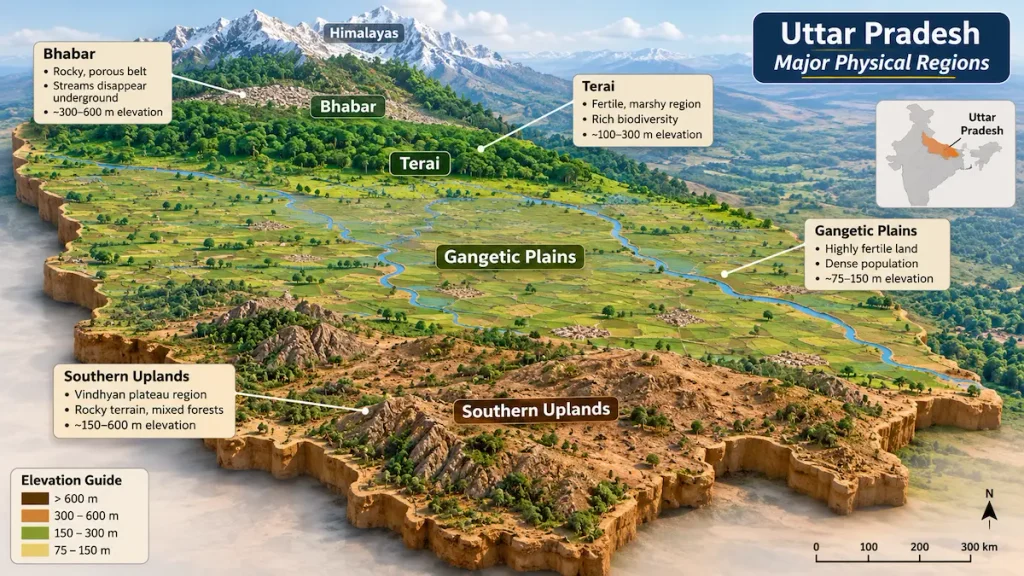
The first thing to understand about Uttar Pradesh’s physical geography is that its landscape is not uniform. Much of the state lies within the vast Gangetic Plain, but the northern edge and southern parts have a noticeably different character. These changes become clearer as we move from the Himalayan foothills towards the southern uplands.
Along the northern edge, near the Himalayan foothills, lie two distinctive belts: the Bhabar and the Terai. The Bhabar is made up largely of coarse materials such as pebbles and gravel. Its porous ground allows much of the water from streams to seep underground. Further south, the Terai has finer sediments and wetter conditions. In parts of this belt, the ground is marshy, with grasslands and forest ecosystems.
Beyond this northern belt stretches the Gangetic Plain, which covers the largest part of Uttar Pradesh. Formed over a long period by deposits carried by rivers, it is generally flat, with a gentle slope towards the south-east. Its landscape includes the Ganga-Yamuna Doab, the central plains and the lower-lying areas towards the south. This broad plain gives much of northern and central Uttar Pradesh its familiar geographical character.
The landscape changes as we move further south. Bundelkhand has a more uneven surface, with rocky ground, low hills and patches of upland terrain. Further south-east, around parts of Mirzapur and Sonbhadra, the Vindhyan region is marked by hills, plateaus, ridges and valleys. Unlike the extensive alluvial plains, these areas have an older geological foundation and a more varied relief.
These differences are important because the physical character of a region influences the conditions found there. A broad river plain, a wetland belt, and a rocky upland are not the same geographical setting. Understanding this contrast helps us make sense of Uttar Pradesh’s regional diversity before examining its rivers, climate, and natural resources.
The Rivers That Shape the State
Rivers are among the most defining features of Uttar Pradesh’s geography. Much of the state lies within the Ganga River system, with several major rivers and their tributaries flowing across its different regions. Together, they form an extensive drainage network that has helped shape the state’s plains and valleys.
The Ganga and Yamuna are two of its most important rivers. The Ganga flows eastwards across the state, while the Yamuna runs along much of its south-western boundary before meeting the Ganga at Prayagraj. This confluence, known as the Sangam, is one of the state’s most recognised geographical landmarks.
Several other rivers contribute to this network. The Ramganga, Gomti, Ghaghara and Rapti drain important parts of the northern and eastern plains. The Gandak flows along the eastern edge of the state, while the Chambal, Betwa and Ken are associated with its southern and south-western regions. The Son also flows through the south-eastern part of Uttar Pradesh before continuing into Bihar.
These rivers have shaped the land over long periods through the movement and deposition of sediments. The Ganga-Yamuna Doab, for example, is the broad tract of land lying between the two rivers. Elsewhere, river valleys and floodplains form distinctive features of the landscape.
Therefore, Uttar Pradesh’s river system is not just a collection of separate waterways. It is an interconnected geographical network that helps explain the formation and character of many parts of the state.
Climate and Rainfall: A State Shaped by the Monsoon
Uttar Pradesh has a tropical monsoon climate, with noticeable changes in temperature and rainfall throughout the year. Its climate follows a familiar seasonal pattern, although the intensity and timing of these conditions vary across the state.
Summer generally extends from March to May, with high temperatures and dry conditions continuing into June. The southwest monsoon usually arrives around June and brings most of the state’s annual rainfall. Winter follows, with temperatures falling and fog becoming common in several parts of the state.
One important feature of Uttar Pradesh’s climate is its dependence on the monsoon. According to the state’s Flood Hazard Atlas, based on rainfall data for the 1961–2010 period, around 89 per cent of annual rainfall occurred during the southwest monsoon season. This concentration means that most of the state’s rainfall is received within a relatively short period.
Rainfall also varies from one part of the state to another. The same atlas records an average annual normal of about 945 mm for eastern Uttar Pradesh, compared with about 813 mm for western Uttar Pradesh. These are long-term averages, not fixed amounts for every year. Actual rainfall can differ considerably from one monsoon to another.
The timing, concentration, and regional distribution of rainfall are therefore important features of Uttar Pradesh’s geographical character.
What Lies Beneath: The Soils and Natural Vegetation of Uttar Pradesh
Much of Uttar Pradesh is covered by alluvial soils, but their character is not identical everywhere. Across the Gangetic Plain, soils range from sandy loam to finer clayey varieties. Their texture and depth differ from one location to another. In the southern districts, the picture changes. Parts of Bundelkhand and the Vindhyan region have red, yellow, and black soils, reflecting the different rocks and geological conditions beneath the surface.
The state’s natural vegetation is equally varied. The northern Terai is known for its sal forests, mixed vegetation and grasslands. In parts of the eastern plains, seasonal swamp forests also occur. These habitats give the region a distinctive natural character.
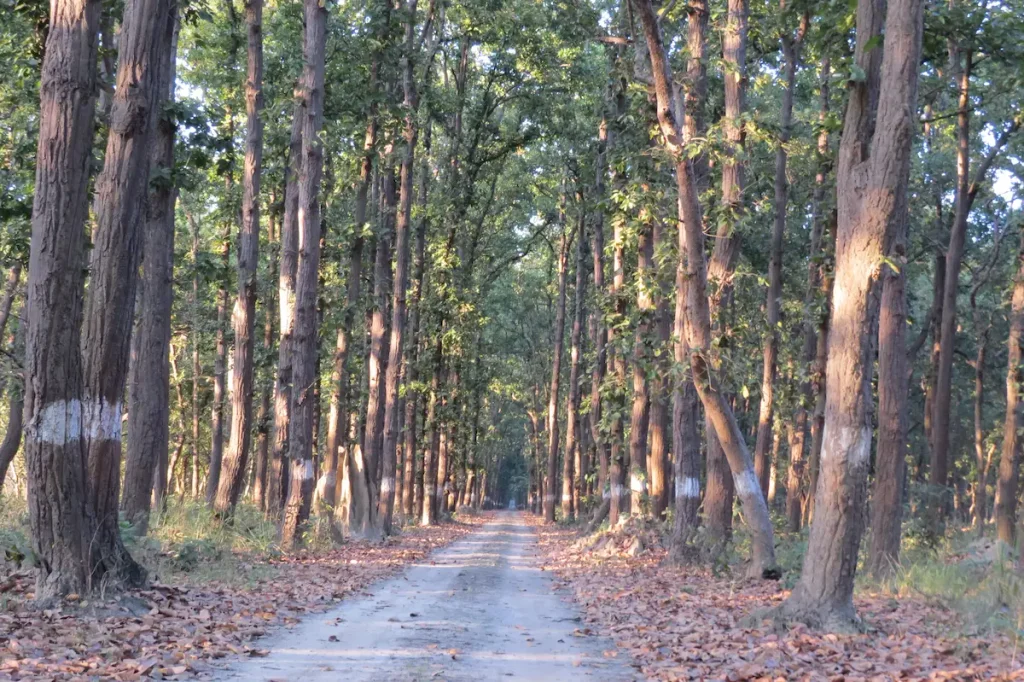
Further south, dry mixed deciduous forests occur across parts of Bundelkhand and the Vindhyan region. Thorn forests are also found in relatively dry areas, including parts of Agra, Mathura and Etawah. Across much of the densely settled Gangetic Plain, however, natural vegetation has been considerably altered by cultivation and human settlement and survives in more limited patches.
The Botanical Survey of India recognises six broad forest types in Uttar Pradesh, reflecting the state’s varied natural conditions. Its vegetation is not defined by one forest landscape, but by several distinct ecological settings.
Natural Resources: Minerals and Groundwater
Uttar Pradesh has natural resources that vary from one region to another. The fertile Gangetic Plain has extensive deposits of alluvial soil and is an important source of groundwater. In contrast, the southern districts have a different geological character, with hard rocks and several valuable mineral deposits.
The southern part of the state is particularly notable for its minerals. Sonbhadra has deposits of limestone and dolomite, while Jhansi, Lalitpur, Hamirpur and Mahoba are known for pyrophyllite and diaspore. High-quality silica sand is also found around Shankargarh in Prayagraj district. These are among the minerals recorded by the Indian Bureau of Mines.
There is also a difference in groundwater availability. The thick alluvial deposits of the central Gangetic Plain form an important groundwater reservoir. In the southern hard-rock areas, water is generally found in weathered and fractured rocks, making its availability more localised and variable.
These differences show that Uttar Pradesh’s natural resources are closely linked to its physical and geological features. The state’s geographical wealth is not the same everywhere; each region has its own resources and natural conditions.
Economy and Livelihoods: What Drives Uttar Pradesh’s Economy?
Uttar Pradesh has one of the largest state economies in India. Its economic activity ranges from agriculture and traditional crafts to manufacturing, trade, and modern services. The state has recorded significant economic growth in recent years, but its economic position needs to be understood more than its overall size. The real question is how this growth is distributed across sectors and how much it improves people’s livelihoods.
According to PRS Legislative Research, Uttar Pradesh’s economy was estimated to grow by 9 per cent in real terms in 2024–25. In the same year, agriculture contributed an estimated 27 per cent of the state’s economy, manufacturing 26 per cent and services 47 per cent, measured at current prices. These figures show that services account for the largest share of economic output, while manufacturing also has a substantial place. Agriculture, however, continues to support a large number of rural households and remains central to the state’s economic and social life.
Agriculture remains a major source of livelihood across the state. Uttar Pradesh is an important producer of wheat, rice, sugarcane, pulses and several other crops. Farming supports not only cultivators but also agricultural laborers, transport workers, traders and people involved in storage and food processing. However, a good harvest does not always mean a secure income for a farming household. Small landholdings, rising input costs, uncertain market prices and limited access to storage and processing facilities can reduce the returns farmers receive from their work. The challenge is not only to produce more, but also to help farmers earn a more reliable return from what they produce.
Beyond agriculture, Uttar Pradesh has a diverse network of traditional industries, manufacturing units and small businesses. Some are closely connected with the identity of particular towns and districts. Aligarh is widely known for its locks and hardware, Moradabad for metal craft and brassware, Firozabad for glass products, Bhadohi for carpets and Kanpur for leather and footwear. These industries bring together local entrepreneurship, manufacturing skills and generations of craftsmanship. Many depend on small and medium-sized enterprises, which provide livelihoods to artisans, workers and traders. Their continued development matters not only for production and trade, but also for sustaining local skills and economic activity. The state’s One District One Product initiative seeks to promote such distinctive local products and industries.
The services sector adds another important dimension to the economy. Trade, transport, banking, education, healthcare, tourism and other services support both households and businesses. As towns expand and economic activity becomes more varied, these services create new forms of work and connect producers with wider markets. Better roads, expressways, airports and logistics facilities can strengthen these connections by making the movement of people and goods easier. However, infrastructure creates lasting economic value only when businesses can use it productively, and local people can access the opportunities it brings.
This brings us to an important concern: economic growth and secure employment are not the same thing. A state may produce more goods and services, attract investment and build new infrastructure, but the benefits must also reach workers, small entrepreneurs and ordinary households. The quality of jobs, the stability of earnings and the ability of young people to find meaningful work matter as much as the headline growth rate.
Uttar Pradesh’s economic potential is considerable, but its progress should not be judged by the size of its economy alone. It must also be measured by whether farmers receive better returns, small industries become more competitive, businesses find room to grow, and people can build a stable livelihood through their work.
Human Development in Uttar Pradesh: Education, Healthcare and Everyday Well-being
Economic growth can change the appearance of a state, but does it necessarily change the quality of life of its people? The answer depends on what happens beyond roads, industries, and government buildings. Can children receive an education that prepares them for life? Can families obtain proper healthcare without facing serious difficulties? Do women have the freedom and opportunity to make their own choices? These are some of the questions that reveal the human side of development in Uttar Pradesh.
Education: From School Enrolment to Meaningful Learning
Uttar Pradesh has a vast school network and millions of children attending educational institutions. But the real measure of education is not how many children enter classrooms; it is what they gain from being there. A child who attends school for years but struggles to read a basic passage or understand elementary mathematics has not received the full benefit of education.
There are, however, signs of improvement. The Annual Status of Education Report (ASER) 2024 found that 27.9 per cent of children in Class III attending government schools in rural Uttar Pradesh could read a Class II-level text. In 2014, this figure stood at just 6 per cent. The improvement is significant and reflects progress in foundational learning. At the same time, it reminds us that much work remains before every child develops the basic skills needed to learn confidently.
The quality of a classroom depends on more than its building, furniture or textbooks. Teachers need adequate support and time to understand the learning needs of their students. Children need an environment where they can ask questions, make mistakes and develop their own understanding instead of depending entirely on memorisation. Education should prepare a young person to think independently, not merely to reproduce information in an examination.
The challenge does not end at the primary level. As children grow older, distance from schools, family circumstances and financial pressures can affect their ability to continue studying. Girls may face additional restrictions related to safety, mobility and social expectations. Their education should not be seen merely as a matter of enrolment; it should help them develop confidence, knowledge and the ability to shape their future. This connects with a broader idea discussed in our article on the real purpose of education.
Healthcare, Women’s Well-being and the Conditions of Everyday Life
A hospital may exist in a district, but that alone does not guarantee good healthcare. What matters is whether a patient can receive timely treatment, whether qualified staff and essential medicines are available, and whether the family can afford the care. For people living in remote areas, the distance to a properly equipped facility can itself become a serious obstacle.
Uttar Pradesh has recorded improvements in some important health indicators. According to NFHS-6 (2023–24), 85.9 per cent of births in the state took place in health institutions, compared with 83.4 per cent in NFHS-5 (2019–21). This indicates progress in access to institutional delivery. However, maternal healthcare cannot be judged by the place of birth alone. Proper care during pregnancy, skilled medical attention, nutrition, and support after childbirth are equally important.
Health is also shaped long before someone enters a hospital. Poor nutrition, unsafe water, inadequate sanitation, and limited awareness of preventive care can affect people throughout their lives. Children who experience malnutrition may face difficulties in physical development and learning, while women with inadequate healthcare can carry health burdens that affect their families as well. These concerns require reliable public services, not occasional attention.
The position of women deserves a particular consideration. NFHS-6 reports that 42.5 per cent of women aged 15–49 in Uttar Pradesh had completed at least ten years of schooling, compared with 39.3 per cent in NFHS-5. The increase is encouraging, but the figure also shows how much educational progress is still needed. More importantly, education must lead to meaningful choices. A woman should have the opportunity to continue studying, access healthcare, travel safely, pursue work and participate in decisions that shape her life. Her progress cannot be measured only through schemes or enrolment figures; it must also be reflected in her independence and dignity.
Basic household services form another part of this picture. Access to electricity, safe drinking water, sanitation and adequate housing influences the everyday security of families. Uttar Pradesh has expanded access to several such services, but availability and quality are not always the same. A household may have a water connection, for example, but the real benefit depends on whether clean water is supplied reliably.
These aspects of human development are closely linked. A healthy child is better placed to learn; education can widen a person’s choices; and dependable public services can protect families from hardships that are difficult to overcome alone. The true test of progress is not merely whether facilities have been created, but whether people can depend on them when they need them.
Uttar Pradesh’s development will remain incomplete if improvements in its economy and infrastructure are not accompanied by better education, accessible healthcare and greater opportunities for its people. Progress becomes real when it reaches the classroom, the hospital and the household, and gives ordinary people a stronger foundation for their lives.
Regional Inequality: Why Development Differs Across Uttar Pradesh
Uttar Pradesh is one state, but the opportunities available to its people are not the same everywhere. The experience of a farming household in western Uttar Pradesh may be quite different from that of a family in the eastern districts or Bundelkhand. Differences in agriculture, infrastructure, industries, market access and public services have shaped these regions in different ways.
I noticed this contrast during my visits to parts of western Uttar Pradesh, particularly around Saharanpur, Deoband and Meerut. The extensive, level agricultural plains, large stretches of cultivated land, and visible presence of sugarcane fields, jaggery-making, and sugar-related industries leave a strong impression. In the Basti region, where agriculture is also central to everyday life, the overall cropping pattern can look different. Sugarcane is grown there too, but it is not as defining a feature of the agricultural landscape as it is in several western districts. The difference is not merely about crops. It also reflects variations in irrigation, farming practices, market connections, and the economic activities that develop around agriculture.
Western Uttar Pradesh: Stronger Agricultural and Economic Connections
Several districts in western Uttar Pradesh have benefited from extensive irrigation, productive farming systems and relatively strong connections with markets. Sugarcane cultivation has supported sugar mills, jaggery production, transport and related businesses. These activities create work beyond the farm itself and connect agriculture with local trade and industry.
The region also has important urban and commercial centres. Meerut, Saharanpur, Muzaffarnagar, Ghaziabad and Noida have different economic profiles, ranging from manufacturing and trade to education, services and urban employment. Proximity to the National Capital Region has provided additional opportunities to parts of western UP through investment, transport links and expanding urban activity.
However, it would be misleading to describe the entire region as prosperous. Large cities and growing industries do not guarantee secure employment or good living conditions for every household. Small farmers face their own difficulties, while workers in informal occupations may have limited job security. Even within a relatively stronger region, opportunities differ from one district, town, and village to another.
Eastern Uttar Pradesh: Population Pressure and Uneven Opportunities
Eastern Uttar Pradesh has fertile agricultural land and a strong tradition of farming. Rice and wheat are important crops, and the region has a rich social and cultural life. Yet, agricultural potential alone has not been enough to create equally strong economic opportunities for everyone.
Population pressure on land, small and fragmented holdings, dependence on agriculture, and limited local opportunities in some sectors can make it difficult for families to secure a stable income. Seasonal migration becomes one way for people to find work elsewhere. Many leave their villages not necessarily because they wish to abandon their homes, but because the work available locally may not provide a sufficient or reliable income.
Certain parts of eastern UP also face recurring floods. When flooding damages crops, houses, roads and other infrastructure, its effects can continue long after the water recedes. Families may lose income, children may face interruptions in schooling, and access to healthcare and other services can become difficult.
Basti and neighbouring districts illustrate why eastern Uttar Pradesh should not be understood through a single problem. Agriculture remains an important foundation of the local economy, and the region has towns, markets, educational institutions and small industries. The challenge is to strengthen these existing foundations and create more opportunities close to where people live.
Bundelkhand: Development Under Water Stress
Bundelkhand faces a different set of challenges. Parts of the region experience recurring water stress, irregular rainfall, and drought vulnerability. These conditions can make farming uncertain and place pressure on rural livelihoods. The rocky terrain and limited water availability in some areas also influence the kinds of agriculture and economic activity that are practical.
However, Bundelkhand should not be defined only by its difficulties. Its natural and cultural heritage, tourism potential, mineral resources, and opportunities in animal husbandry offer possibilities for economic development. Better water management, local employment and investment suited to the region’s conditions can help strengthen its rural economy. The important point is that development strategies must respond to local realities rather than rely on the same approach everywhere.
Central Uttar Pradesh: The Influence of Major Urban Centres
Central Uttar Pradesh has a different position within the state. Lucknow serves as the state capital and an important centre of administration, education, healthcare and services. Kanpur has a long industrial and commercial history, while other towns support agriculture, trade and local industries.
These centres contribute significantly to economic activity, but their presence does not mean that every surrounding district enjoys the same level of infrastructure, employment or access to quality public services. A major city may attract investment and offer a wider range of opportunities, while people in nearby rural areas continue to face difficulties in accessing them.
This is why regional comparisons should not stop at the names of major cities or the size of a district’s economy. They should also consider whether people in smaller towns and villages can access good schools, reliable healthcare, transport, markets and meaningful work.
Development Must Reach Beyond the Strongest Centres
The differences across Uttar Pradesh are not the result of geography alone. Natural conditions matter, but so do historical investment patterns, infrastructure, the location of industries, the quality of public services and the effectiveness of governance. Some disadvantages can be reduced through better planning and investment; others require solutions suited to local conditions.
A water-management strategy that works in a flood-prone eastern district may not be appropriate for a drought-vulnerable area of Bundelkhand. Similarly, the industrial and transport opportunities of western UP cannot be copied everywhere without considering local resources, skills and needs.
The aim should not be to make every region identical, but to ensure that people in every region have a fair chance to progress. A farmer should be able to earn a reasonable livelihood without being forced into distress migration. A student should not have fewer opportunities because of the district in which they were born. A family should not have to travel an unreasonable distance for essential healthcare.
Uttar Pradesh’s progress will become more meaningful when its benefits reach beyond a few cities and stronger districts, extending to smaller towns, villages and communities across the state. The measure of balanced development is not whether every region looks the same, but whether people, wherever they live, have a genuine opportunity to build a better life.
Politics and Governance: The Decisions That Shape Development
Uttar Pradesh holds considerable political weight in India. It sends 80 members to the Lok Sabha and has a 403-member Legislative Assembly. Decisions made by its government affect a population larger than that of many countries, spread across regions with different needs and circumstances. This makes the quality of political leadership and administration especially important.
Over the years, successive governments have brought different priorities to the state. Infrastructure, law and order, welfare programmes, agriculture, industrial investment and employment have all featured in their development agendas. Some initiatives have brought visible changes; others have struggled to deliver their intended benefits. A meaningful assessment must look at both. Political claims alone cannot tell us how much a policy has improved people’s lives.
Political Leadership and the Changing Priorities of Uttar Pradesh
The priorities of a government influence where public money is spent and which problems receive attention. One administration may place greater emphasis on expressways and industrial investment, while another may focus more heavily on welfare delivery, rural development or social programmes. Each can contribute to development, but the value of a policy depends on its outcomes, not the prominence it receives in political speeches.
A state also needs continuity in areas that require years of sustained effort. Building roads and attracting investment are important, but they must go hand in hand with better education, productive employment and dependable public services. Welfare support can help families facing hardship, while opportunities for education, skills and decent work can strengthen their ability to secure a better future.
Development should not be treated as a contest in which each new government seeks credit for its own announcements. Useful work needs to continue, weaknesses need to be addressed, and public welfare must remain the priority. Governments may change, but the everyday needs of farmers, students, workers and families remain.
From Policy to Practice: Implementation and Accountability
A government can announce a scheme, approve a project, and allocate funds in its budget. But these steps do not guarantee that the intended work will be completed or that people will benefit from it. Funds must be used properly, projects must be completed, and public facilities must continue to function after they are built.
Uttar Pradesh’s budget figures illustrate this concern. According to PRS Legislative Research, the state spent about 26 per cent less on capital outlay in 2024–25 than it had budgeted. Across the four years from 2021–22 to 2024–25, actual capital outlay was, on average, 28 per cent below the budgeted amount. This gap does not, by itself, explain why the money remained unspent or establish that individual projects failed. It does, however, raise a serious question about the state’s ability to turn financial plans into completed assets and public infrastructure.
Governance is not limited to decisions taken in Lucknow. District administrations, municipal bodies and Gram Panchayats have important responsibilities in addressing local needs. A village’s drinking-water problem, a town’s waste-management difficulties or the upkeep of a local road requires attention from institutions that understand the area and can respond to its people. These institutions need adequate resources, capable officials and clear accountability.
Citizens also have a role in strengthening governance. Access to information, functioning grievance-redressal systems and the freedom to question delays or irregularities are essential in a democracy. Corruption, wherever it occurs, can divert public resources, weaken institutions and erode people’s trust in government. Transparent procedures and responsible public participation help hold authorities accountable.
The worth of a government is not measured only by what it promises or builds, but by what continues to work and whom it reaches. For Uttar Pradesh, lasting progress will depend on political decisions being matched by capable administration, responsible use of public money, and institutions that serve people fairly.
Society, Culture and Identity: The Human Side of Uttar Pradesh
A state is not shaped by its government alone. Its character also comes from the way people live, think, treat one another, and respond to change. In Uttar Pradesh, family relationships, community ties, religious beliefs and long-established social customs continue to influence everyday life. These connections give society a sense of belonging, but some inherited practices can also restrict people’s choices and opportunities.
Caste remains one of them such reality. It can influence social relationships, marriage, local power structures, and the way people are treated in different settings. Religious and community identities also carry considerable importance in public and private life. These identities are part of people’s histories and sense of belonging; the problem arises when they become grounds for discrimination, mistrust or exclusion. A society makes genuine progress when a person’s dignity and opportunities are not determined by the community into which they are born.
Uttar Pradesh’s cultural richness deserves equal attention. Its traditions have developed through centuries of interaction among different communities, beliefs and ways of life. This can be seen in its literature, music, architecture, crafts, food and everyday customs. But culture is not merely a collection of festivals, monuments or inherited practices. It is also reflected in how people think, what they value, and how they relate to others. If you would like to explore this idea further, read my article on what culture means and how it shapes human life.
At the same time, society is not standing still. Young people are seeking education, employment, and greater independence. Migration exposes families to different ways of living and thinking. Women are pursuing their ambitions, even as unequal responsibilities, social expectations and restrictions continue to limit many of their choices. Differences between generations are also becoming more visible: what parents consider secure or acceptable may not always match what their children hope to achieve.
This changing society raises an important question: can people hold on to what is valuable in their traditions while questioning practices that deny others equal respect and opportunity? Preserving cultural identity should not mean resisting every change. Nor should progress require people to abandon their roots. A confident society should be able to respect its heritage while making room for new ideas, individual freedom, and mutual understanding.
Ultimately, development is not only about better roads, schools, hospitals or industries. It also depends on whether people value education, respect women’s choices, reject discrimination, cooperate with one another and remain open to improvement. Governments must provide capable institutions and fair opportunities, but society has a responsibility to make constructive use of them. A government can build the foundations of progress, but a society’s values and actions help determine how far that progress reaches.
Environmental Challenges and Sustainable Development
A state cannot measure its progress only by the roads it builds, the industries it attracts, or the size of its economy. It must also consider the condition of the natural environment that makes everyday life possible. What is the value of economic growth if the air becomes harder to breathe, water becomes unsafe, and natural resources are gradually exhausted? This is an important question for Uttar Pradesh, where development and environmental protection must advance together.
Air pollution offers one of the clearest warnings. In IQAir’s 2025 World Air Quality Report, Loni in Uttar Pradesh was ranked the world’s most polluted city, with an annual average PM2.5 concentration of 112.5 micrograms per cubic metre. This is not a temporary reading from a particularly bad day; it reflects the average concentration recorded over the year. Vehicle emissions, industrial activity, construction and road dust, and the burning of waste all contribute to the wider pollution burden. The problem cannot be solved through seasonal restrictions alone. It requires cleaner transport, effective pollution control, better urban planning and consistent enforcement of environmental standards.
Water presents a less visible, but equally important, challenge. Groundwater supports a large share of the state’s agricultural, domestic and industrial needs. According to the Central Ground Water Board’s 2025 assessment, the overall stage of groundwater extraction in Uttar Pradesh stood at 70 per cent. There has been some improvement since 2017: the number of over-exploited assessment units declined from 91 to 54. This is encouraging, but it does not remove the need for careful management, particularly in areas facing greater pressure. Water quality matters just as much. Untreated sewage, industrial discharge and poorly managed waste continue to threaten rivers and other water bodies. For instance, the Ganga still has a polluted stretch in Uttar Pradesh, although the 2025 assessment indicates improvement compared with 2018. A river’s importance cannot be measured only by its place in our history or culture; its condition must also reflect the care we give it.
Climate-related risks make these concerns more complex. Uttar Pradesh’s climate assessments identify heatwaves, floods, droughts, changing rainfall patterns and other extreme weather events as important challenges. Such risks do not affect every district in the same way, but they can disrupt agriculture, damage infrastructure and place additional pressure on communities. Preparing for them requires reliable early-warning systems, climate-sensitive planning, better water management and local disaster preparedness. Waiting for a crisis to expose weaknesses is far more costly than preparing before it arrives.
Moreover, the state’s forests, wetlands and wildlife habitats also deserve greater attention. Protected areas such as Dudhwa and Pilibhit preserve valuable ecosystems and provide shelter to diverse wildlife. But conservation cannot end at the boundaries of protected areas. Habitat loss, fragmentation, encroachment, and pressure on natural resources can weaken the wider ecological network on which wildlife and surrounding communities depend. Protecting these landscapes is not a luxury; it is part of safeguarding the state’s natural heritage.
These challenges point towards a larger responsibility. Sustainable development requires more than isolated clean-up campaigns or the planting of trees on particular occasions. It demands functioning sewage-treatment systems, responsible industrial practices, reduced dependence on wasteful resource use, rainwater harvesting, groundwater recharge, cleaner energy and the protection of forests and wetlands. It also requires public participation and institutions that monitor whether environmental rules are followed.
Development should not leave behind a cleaner skyline at the cost of a damaged natural environment. Uttar Pradesh needs growth that improves people’s lives while protecting the air they breathe, the water they depend on, and the natural wealth they will pass on to future generations.
Uttar Pradesh’s Strengths and Untapped Opportunities
Potential is easy to praise, but much harder to turn into progress. Uttar Pradesh has a large workforce, a productive agricultural base, established local industries, a strategic location, and a rich cultural heritage. These are significant advantages. However, their real value depends on whether they create better livelihoods, stronger businesses, and wider opportunities for ordinary people.
A Young Population: Turning Human Potential into Strength
One of Uttar Pradesh’s most important advantages is its population structure. According to the Reserve Bank of India’s January 2026 analysis, approximately 62.8 per cent of the state’s population is projected to be in the working-age group of 15–64 years in 2026. This share is expected to rise to 66.1 per cent by 2036. It gives the state a substantial potential workforce, but a large working-age population does not automatically translate into economic strength. People need education, practical skills, good health and opportunities to use their abilities.
Switzerland offers an interesting example of how education can be connected more closely with employment. Around two-thirds of young people there pursue vocational education and training after compulsory schooling. Its dual system combines classroom learning with paid workplace training, allowing students to develop occupational skills while gaining practical experience. More than 90 per cent of its vocational education students follow this apprenticeship-based route. Uttar Pradesh cannot simply replicate a system developed for a different economy, but it can draw an important lesson from it: young people need meaningful pathways from education to work. Stronger apprenticeships, industry-linked training and practical learning could help prepare them for opportunities in manufacturing, agriculture, healthcare, technology and other sectors.
Agriculture and Food Processing: Creating More Value Locally
Uttar Pradesh’s agricultural strength offers opportunities well beyond the production of crops. Its substantial output of food grains, milk, fruits and vegetables provides raw material for food processing, dairy products, packaging, storage and related businesses. The Ministry of Food Processing Industries identifies approximately 65,000 food-processing units in the state, employing around 2.55 lakh people.
There is room to strengthen this foundation through better cold storage, processing facilities, quality testing and market connections. Instead of selling agricultural produce only in its raw form, farmers and local businesses can benefit from processing and adding value closer to production centres. This can create additional employment while giving agricultural products access to wider markets. The opportunity is not just to produce more, but to create more value from what the state already produces.
Local Enterprise, Exports and Wider Market Access
Uttar Pradesh’s traditional industries and specialised products are another important strength. Banarasi silk, Lucknow Chikankari, Kannauj perfumes, Moradabad metalware and Bhadohi carpets represent skills and enterprises that have developed over generations. According to NITI Aayog’s Export Preparedness Index 2024, the state had 77 geographical indication (GI)-tagged products and ranked fourth among India’s large states, with exports worth approximately ₹1.72 lakh crore in 2023–24.
These figures point to an established base for trade, but the opportunity is not limited to selling more products. Local producers need consistent quality, modern designs, reliable packaging, recognised certification, and access to buyers. Better digital platforms and branding can also help smaller enterprises reach customers outside their immediate markets.
Connectivity can strengthen these possibilities. Uttar Pradesh’s location in northern India, together with its road, railway, expressway and freight-corridor networks, offers scope for more efficient movement of goods. Industrial and logistics connections can support manufacturing and exports, but their benefits should also reach smaller towns and local businesses. The aim should be to connect local production with larger markets, rather than allow economic activity to remain concentrated in a few established centres.
Heritage, Tourism and Emerging Industries
Uttar Pradesh’s historical, cultural and natural heritage gives it considerable tourism potential. Its historic cities, architectural landmarks, pilgrimage destinations, traditional crafts and protected natural landscapes attract different kinds of visitors. Responsible tourism can support local guides, artisans, transport operators, accommodation providers and small businesses. Therefore, its success should be measured not only by visitor numbers, but also by how much opportunity it creates for surrounding communities.
Newer sectors offer another avenue for diversification. Electronics manufacturing, information technology, digital services, defence-related industries and other technology-based businesses can create opportunities for skilled workers and entrepreneurs. The growth of such sectors will depend on reliable infrastructure, trained people, research, investment and stronger links between educational institutions and industry.
Uttar Pradesh has several advantages, but they should not be viewed in isolation. A young population needs productive work; agricultural output needs value addition; traditional skills need access to wider markets; and infrastructure needs businesses capable of using it. The greatest opportunity lies in bringing these strengths together so that progress in one area supports growth in others. Ultimately, the state’s potential will be judged not by the number of advantages it possesses, but by how effectively they improve the lives and prospects of its people.
Uttar Pradesh Development: The Way Forward
Uttar Pradesh does not lack potential. It has a large workforce, a strong agricultural base, established industries, growing infrastructure, and a rich social and cultural heritage. The greater challenge is to make these strengths work together and ensure that progress reaches people across different regions and sections of society. This requires more than new projects or policy announcements. It calls for consistent priorities, capable institutions, responsible leadership and a society willing to participate in its own development.
Make Education, Skills and Healthcare Work for People
The first priority should be to strengthen people’s ability to build secure and productive lives. Schools need to focus on actual learning, not merely enrolment, attendance or examination results. Children should develop reading, communication, reasoning and problem-solving abilities. This requires supported teachers, regular assessment of learning and timely help for students who fall behind. At the secondary level, better access and guidance can help more young people continue their education.
Skill development also needs a closer connection with employment. Training programmes should be designed with local industries and employers so that young people acquire abilities that are genuinely needed. Germany offers a useful example through its apprenticeship system, in which vocational education combines classroom learning with workplace training. One particularly relevant feature is that smaller businesses can form training consortia and share responsibility for apprentices, rather than each employer having to provide the entire training structure independently. Uttar Pradesh could adapt this approach by bringing together industrial associations, local businesses, polytechnics and training institutions. This would be particularly useful in districts where individual small enterprises cannot afford to train young people on their own. However, apprenticeships must lead to recognised skills, meaningful workplace experience and fair treatment, not become a source of cheap labour.
Healthcare deserves the same attention. Facilities must have qualified staff, essential medicines, functioning equipment and reliable services. A building or a scheme has limited value if people cannot depend on it when they need help.
Turn Economic Activity into Reliable Livelihoods
Economic growth matters most when it creates opportunities for people to earn a stable living. Uttar Pradesh needs to strengthen small and medium-sized businesses, encourage employment-generating industries and make it easier for local entrepreneurs to establish and expand their enterprises. Investment should be assessed not only by the amount announced, but also by the businesses that actually begin operating, the jobs they create and the opportunities available to local workers.
Agriculture requires a similar shift towards better returns. Farmers need stronger links with storage, processing, transport and markets. Farmer Producer Organisations, cooperatives and local enterprises can help small producers combine their purchasing power, improve bargaining and access services that may be difficult to obtain individually. Food-processing facilities should be developed near suitable production areas, with dependable electricity, quality testing and transport connections.
Japan’s One Village One Product movement, which began in Oita Prefecture in 1979, offers another useful lesson. Local communities identified products and resources associated with their areas, improved their quality and developed ways to reach wider markets. The idea later spread to other countries through development initiatives. Uttar Pradesh already has distinctive products and traditional skills, but local development should involve more than assigning a product to each district or promoting it through advertising. Producers need technical support, better designs, quality standards, packaging, finance, and reliable buyers. Most importantly, local communities and businesses should help shape these initiatives. The lesson is that development becomes more sustainable when people build on their own resources and skills rather than depend entirely on government promotion.
Develop Every Region According to Its Needs
A state as geographically and economically diverse as Uttar Pradesh cannot rely on one uniform development model. Flood-prone eastern districts need stronger drainage, flood preparedness, and resilient infrastructure. Water-stressed parts of Bundelkhand require locally suitable water conservation and livelihood strategies. Areas with established industries need better technology, skills and cleaner production, while smaller towns across the state need improved public services, transport and opportunities for local enterprise.
Water management provides a useful example of why solutions must respond to local conditions. Israel has invested in wastewater treatment and reuse, with treated water used extensively for agricultural irrigation. Its experience shows how water that would otherwise become waste can be treated and put to productive use. Uttar Pradesh cannot reproduce Israel’s system on the same scale, given differences in investment, infrastructure, water systems and institutional capacity. But it can adapt the principle by improving sewage treatment, reusing treated wastewater where safe and suitable, promoting rainwater harvesting and strengthening local water management. In parts of Bundelkhand, these measures should complement watershed development, restoration of traditional water bodies and careful management of groundwater.
Planning should therefore begin with a clearer understanding of district-level needs and resources. Local bodies, district administrations, technical institutions, businesses and residents should have meaningful roles in identifying priorities and monitoring projects. Kerala’s experience with participatory local planning offers a useful lesson: local development plans can be prepared through Gram Sabhas, working groups and elected local governments, supported by technical expertise and public resources. Uttar Pradesh cannot copy Kerala’s model wholesale, given its much larger population, different administrative capacity and regional conditions. But it can strengthen Gram Panchayats, urban local bodies and district planning so that decisions are better informed by local realities.
Make Leadership Accountable and Society More Aware
Development also depends on the quality of political decisions and the institutions responsible for carrying them out. Governments may have different priorities, but public welfare should remain central to every administration. Useful policies need continuity, public money must be used responsibly, and completed projects must be maintained. Progress should be judged through visible outcomes: whether schools are teaching, hospitals are functioning, public services are dependable, and people are gaining better opportunities. Opposition parties, independent institutions, the media and citizens all have a role in questioning decisions and demanding accountability.
Society, too, has a responsibility. Education and awareness should help people look beyond prejudice and assess public issues with greater understanding. During elections, citizens should consider a candidate’s integrity, ability, public record, and commitment to serving the community. Caste and religious identity should not become substitutes for judging performance, nor should money, liquor or other inducements determine political choices. Differences of faith, community and opinion are part of a diverse society; they should not prevent people from working towards shared goals.
This responsibility must be understood fairly. Citizens cannot be expected to compensate for poor administration or failures of public institutions. Government must protect rights, provide essential services and create fair opportunities. But an aware society is better placed to question those in power, resist divisive appeals and participate constructively in public life. A government can build the foundations of progress, but the values, choices and participation of society help determine how far that progress reaches.
Uttar Pradesh’s future will depend on bringing these responsibilities together. The aim should not be growth that looks impressive only in statistics, but progress that people can experience in their education, work, health, security, and everyday lives.
Conclusion
Uttar Pradesh stands at an important point in its journey. Its potential is immense, but potential alone does not change lives. That happens when a child receives a meaningful education, a farmer earns a fair return, a young person finds dignified work, and a family can depend on essential public services.
The state’s progress cannot be measured only by the size of its economy, the number of projects it builds, or its political influence. It must also be seen in the opportunities available to its people and the dignity with which they are able to live.
The real progress of Uttar Pradesh will begin to show when a better future is no longer determined by where a person is born, but becomes a possibility for everyone, wherever they call home.